

Skin
"forge a skin"
forging an identity, removing skin to reveal true self

After Elena’s lecture, I had a delicate and unexpected moment of self‑reflection. I began thinking about my identity as a Czech, and a European, living in the UK.
Over the years I’ve encountered many opinions, some subtle, some hidden, and some painfully direct. All reminded me the one thing I'm painfully conscious about, that I was seen as
“other.”
The most memorable was the night of the Brexit referendum, when the atmosphere shifted and I experienced the weight of being foreign, and a direct rejection from my community on that very night.
After Elena's lecture, I realised that, slowly and quietly, I have been hiding my Czech identity. I have been proving myself through education, intellect, and business achievements. As if I needed to justify my right to belong.
This realisation created a sudden need to shed the protective layer I had built around myself. In the true spirit of the palimpsest,
I wanted to dig through the layers and uncover what I had buried. The metaphor of “forging a skin” while forging an identity captures this perfectly.
The external skin has been like a performance costume made for show, shaped alongside and to hide my internal sense of who I am.
This process is not just about appearance, it is about the boundary between my inner world and the social environment that presses against it.
Aligning with Charles H Cooley, and the idea of Imagination of judgment leading to shame. I am constantly performing rather than exhibiting my own personality.
I felt like this fake build up exterior must be removed.
Just
because
you
fit
doesn’t mean
you
belong
February
&
March
latex experiments

trying to separate, detaching myself from the forged skin
I wanted to dig under my own skin, metaphorically, of course.
To peel back the layers I had built over years of assimilation and find the long‑buried Czech-ness underneath.
I wanted to feel that peel physically.
I needed to make something that wasn’t only material, but embodied. Something that demanded touch, presence, and sensation. Something that let me confront what I had covered, softened, or hidden, and bring it back into the light.
I started with painting liquid latex over my index finger. it was a simple beginning process, as much as I was learning handling the medium.
I applied and let dry 6 layers.
after I peeled it off, I could see the grooves. The level of detail imprinted onto the latex was astonishing.
I took this tiny peace of latex, and started scanning. I have created a image, that evokes peeled skin shedded, yet resembling a petal. Theres a poetry and narrative of identity. my thought process continued .
If each experience is a new layer, than some of these are blending with the old layers, some are made into new skins.
Because each layer is new skin.
I wanted to see if I can make more of me captured in latex. I wanted to know, if I can shed all my build up skin.
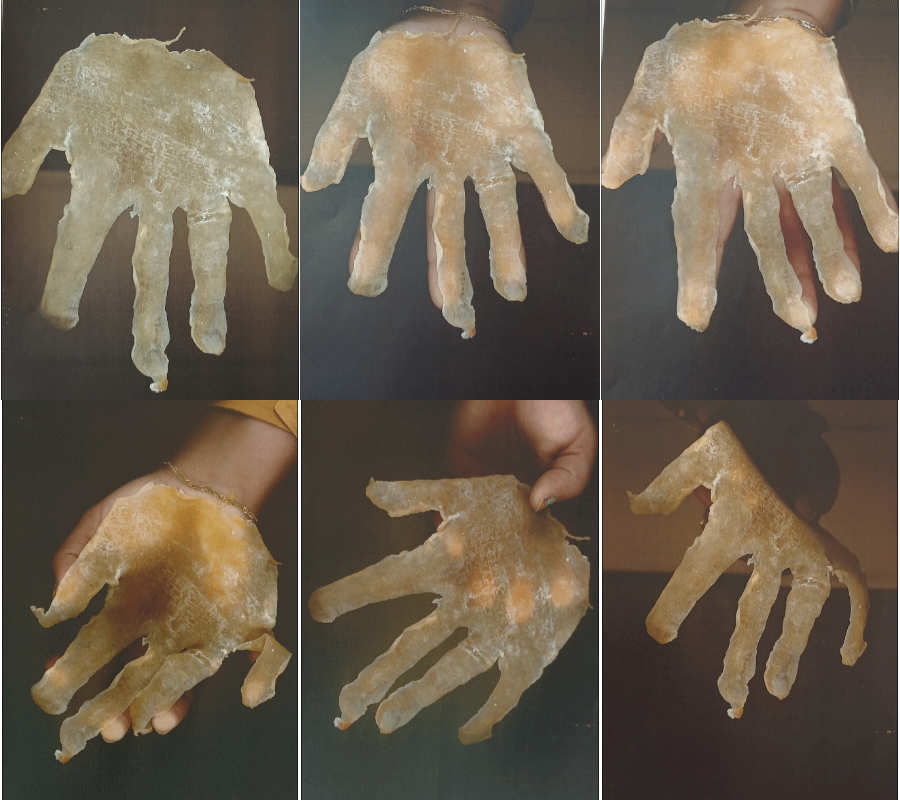
I created a series of casts using Plaster of Paris — first of my hand, then my knee, and finally my foot. I wasn’t entirely sure what to expect from the process. Once each cast had dried, I poured several layers of liquid latex into the mould, building up the thickness until it felt stable enough to peel out.
What I did not anticipate was the sheer physical force required to remove the latex. The action was unexpectedly intense and
deeply unpleasant. My shoulders tightened as the sensation made me recoil.
The latex stretched and resisted, clinging to every contour. It did not want to be peeled away. It did not want to be removed from the comfortable, tidy groove it had settled into.
When I finally managed to extract the moulded latex, its appearance was startlingly skin‑like. It wobbled, is was translucent, and moved with an unsettling softness.
The result was visceral, uncomfortable and precisely because of that, the process embodied the physicality of shedding, the resistance of what has been long attached, and the discomfort of exposing what lies beneath.


The skin experiment continued for several weeks.
I found myself strangely drawn to the abjective, repulsive nature of the process. I was systematically excluding the uncomfortableness and feelings of rejection, displacement, and self‑erasure long buried beneath newer layers of identity.
Working with latex became a way of approaching these emotions indirectly, through the material body rather than my own.
Bhabha argues that there is no such thing as a pure or original self. The identity is always a hybrid, a composite, formed through cultural interaction and negotiation. In The Location of Culture, he talks about the myth of cultural purity and describes identity as something produced “in‑between” cultures, through processes of translation, displacement, and collaboration (Bhabha, 1994).
British society is a striking example of this paradox. As a culture profoundly shaped by its colonial history, yet often presented (particularly through right‑wing political narratives) as authentically “pure” British lineage. The myth of the original persists even when the historical reality contradicts it.
As a part of my experiments, i placed the the forged, latex “skin” on display, simply to provoke conversation. However the skin began to evolve in ways I had not anticipated.
I did not know that latex reacts to UV light and temperature. Over time, it darkened in places, stiffened, and lost some of its elasticity.
It began to mummify itself, becoming more fragile and less flexible.
The material was performing a transformation of its own.
Deleuze writes about the body not as a fixed entity but as a site of becoming. Deleuze and Guattari describe the body and mind as something that are always in motion, always shifting, always forming new relations (1987). Identity, in this sense, is not a static essence but a process, a continual negotiation between internal states and external conditions.
The latex skin enacted this Deleuzian becoming. It refused to stay what it was at the moment of casting.
It changed colour, texture, and flexibility depending on its environment.
It didn’t become a replica of my skin, is was shaped by forces beyond my control. Its transformation mirrored the instability of identity itself.
The repulsive looking latex skin became more than an material representation of the idea of removing skin. It became a metaphor for the
impossibility of returning to an imagined “original” self, and for the continuous, unpredictable processes that form identity.