ART-ists influence
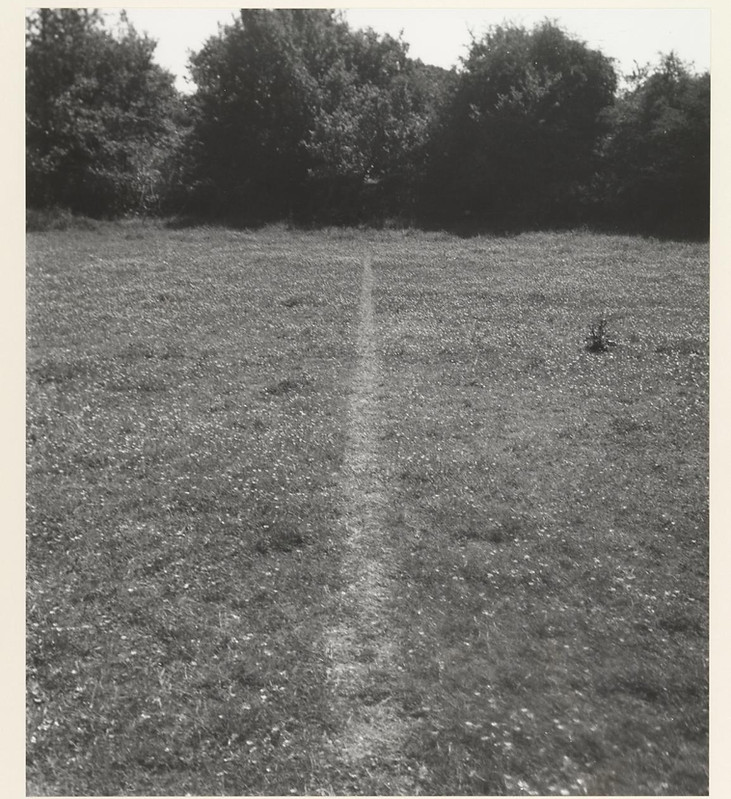
Richard Long,
Line Made by Walking 1967
Repetitive actions will create markings
in extreme, these markings will become permanent
Long walking can be seen as spacio-temporal intervention.
He uses time and distance as a medium.
Walking is his way to "articulate ideas about time and space"
His intervention is temporary, as by stopping the action of walking back and forth, the nature will reclaim the path and becomes virginal again.
Reflection:
Richard Long’s Line Made by Walking has become one of the biggest influences on my work. His art carries a powerful phenomenological implication: the line as a life‑line, a physical manifestation of a specific duration of time spent in a specific place.
The line is an embodied record of movement, repetition, and presence.
During March and April, the idea of measuring time became central to my practice. I was searching for my own visual way to experience duration, not as a number or a unit, but as something lived. Long’s work helped me see that a line can hold time inside it.
After my experiment with palimpsest, where i was trying to recreate an image in thread. Although I didn’t feel the outcome was successful or something I wanted to continue to perfect, something important happened.
I realised that thread is a line.
where Long is creating a line that becomes an integral part of land, I am creating a line that becomes integral to my story. The interesting conversation is happening at the moment, where Long's line although integral to the moment will eventually disappear without any trace, theere can be argument, tyhe space has been changed for the duration of the line. Stitch line is only as permanent as the stitches remains on the fabric. These stitches can be removed. However, its the base material, that will determine, if the removal is with or without traces.
This recognition became integral to my work. Even when the experiment didn’t produce the result I hoped for, it revealed something essential about my process. I am not just making lines, I am tracing my own duration, my own movements, my own lived experience, my memories.
Each thread, each mark, each repeated gesture becomes a record of time spent, attention given, and presence embodied.
and just like Long, I am learning that the line is not simply just draw, it is something that is lived.
Arte Povera
&
Mono Ha
-
Arte Povera was a radical Italian art movement from the late 1960s to 1970s whose artists explored a range of unconventional processes and non-traditional ‘everyday’ materials
-
Mono-Ha Japaneesse answer to Arte Povera is engaging with materials and exploring their properties. They reveal world as it is.
-
Materials used by the artists included soil, rags and twigs. In using such throwaway materials, they aimed to challenge and disrupt the values of the commercialised contemporary gallery system.
-
Making art without the restraints of traditional practices and materials.
-
Often critiqued for lack of polish and skills displayed in the making.

M. Pistoletto Venus of the Rags

Noriyki Haraguchi, Rope and plaster (2019)
this work really intrigued me for its deconstructive quality.
Almost accidentally revealing hidden layers.
When I first came across this art, i just found it interesting, as my research continue, i keep looking back to this image more often.
After my research took turn and start following a route of identity and post-colonialism, this work became somewhat on a forefront of my thought.
Since I was introduced to palimpsest, this work suddenly started to make even more sense.
Revealing what is hidden. Its covered up, but can be found, the layers were never erased, they are there to coexist with the current layers, they are forging and influencing the current layers.
As the now could not be without the past.
LEE UFAN
He was not making art.
Artists ability to make things is muffled by technology.
Krzysztof Gostkowski
Krzysztof Gostkowski Un Capitolo Nuovo
-
A symbolic composition that speaks of transition, breaking routines, and the courage to create on one’s own terms.
-
A broken red pencil placed on a golden background doesn’t just "bleed" a vivid stream of resin — it becomes a manifesto of artistic freedom.
-
This piece questions the very nature of creation. Can a tool that no longer draws still inspire? In a world shaped by expectations and systems imposed since childhood.
-
At the core of his creations lies emotion, symbolism, and message
-
Experiments with materials such as resin, wood, yesmonite, plaster, paper, acrylics, and even everyday
-
creating unique works of art that blend functionality with artistic expression.

challenges the idea that
USEFULNESS is the only measure of value.
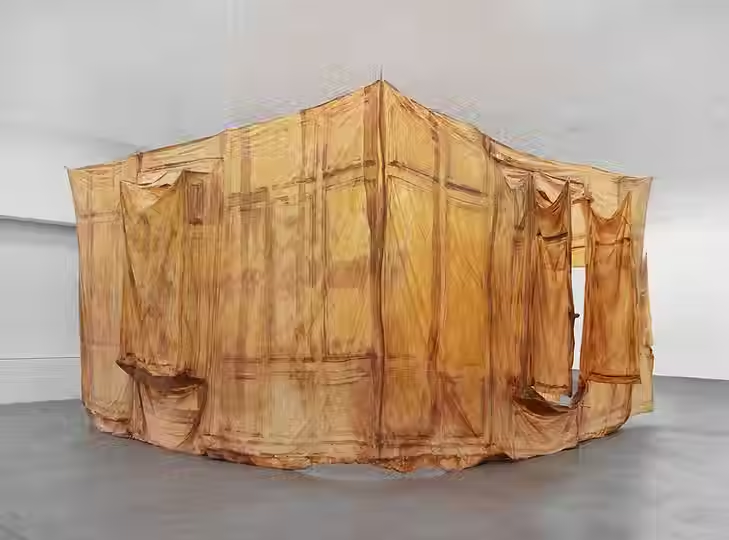
Heidi Bucher
Bucher began applying her signature latex medium to the surfaces of domestic objects and spaces, aligning women’s clothing with these designated “feminine” spaces.
Allowing the latex mixture to harden, then peeling it off, Bucher produced translucent skins that held elements of paint, rust, dirt, and the minute details and markings of the architecture.
The removal of the latex from the architectural space required a great deal of both physical strength and delicate dexterity.