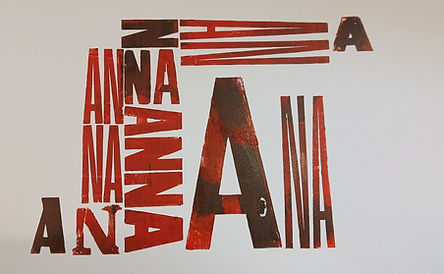
Print Identity

I began these experiments as a way of interpreting a section of Gayatri Chakravorty Spivak’s "Can the Subaltern Speak?", particularly, where she comments and cites Marx’s (1852) analysis of class formation. The passage that struck me most was Marx’s distinction between structural grouping and lived community:
“In so far as millions of families live under economic conditions of existence that separates their mode of life… they form a class. In so far… the identity of their interests fails to produce a feeling of community… they do not form a class.”(Marx, 1852, cited in Spivak, 1988)
I was reflecting on my own experience of being labelled by my community as immigrant, European, Czech.
These labels create an truly an artificial membership. Like grouping people, who may never meet, they have very little or nothing in common.
I began to question how this imposed identity feels from within.
Do we look different?
Do we behave differently?
How does the “native” recognise the “other”?
What does it mean to be grouped with strangers on the basis of origin alone?
To explore these questions materially, I booked myself onto a printmaking workshop. I wanted to learn letterpress and lino printing.
During my first lino‑cutting session, we were instructed to create a quarter‑turn tile. Initially, I resisted the task. I was more interested in the medium rather than the exercise.
At that moment in my module journey, I was still working with the idea of being
interwoven into my environment, and the environment being interwoven into me, and palimpsest was making its way into my work..
With my mind full of baskets, I carved a tile that resembled a zoomed‑in textile weave, with interrupted connections.
When I hand‑printed it, I was surprised by how much I enjoyed the process. In that moment, I felt as though I had been born to print.
In the spirit of the palimpsest, I experimented with overlaying colours, misalignment, and layering with tissue. The build‑up of marks echoed the layering of identity. As part of my self‑directed exploration, I turned to the blue onion (Zwiebelmuster) patterns I remembered from childhood. These motifs are themselves cultural hybrids: European reinterpretations of Chinese peaches, pomegranates, peonies, asters, and bamboo. Their hybrid nature appealed to me as a metaphor for cultural translation, but although the prints were aesthetically pleasing, they ultimately felt like a conceptual dead end.
They did not push my theoretical enquiry forward.


I moved onto letterpress. I originally wasn't hugely excited about, however it became a little obsession.
I was introduced to the university’s treasure: the Alexandra Press — a beautifully engineered historical machine from era that celebrated the British Empire. It felt like the perfect instrument for my next idea.
With Spivak’s critique of minority voicelessness in mind, my thoughts returned to the night of the Brexit referendum. That moment forced its way back into my consciousness. Again, I was being categorised and ordered, yet had no say in the matter.
Ten years later, the atmosphere remains clouded by the slogans and misinformation of that time. As a white immigrant in a predominantly white society (Gov.uk),
I am still grouped and defined by my origin and nationality rather than my personality, skills, or lived experience.
Homi K. Bhabha’s argues that there is no such thing as a pure or original identity; all identities are hybrid, formed through cultural negotiation, translation, and displacement (Bhabha, 1994). Britishness itself is a paradox: a culture profoundly shaped by colonial histories, yet often presented, as authentic British. The myth of the original persists even when the historical reality contradicts it.
Bhabha’s concept of the Third Space, ( the in‑between zone where hybrid identities are formed ) became a key lens through which I understood my own position.
This hybridity became central to my letterpress experiment. I was handed a box of miscellaneous wooden type where no two letters the same font.
Some differences were obvious; others required close inspection.
This felt metaphorically perfect. I arranged the two letters of my name into a repeated pattern, selecting and mixing the typefaces.
I wanted to express the blending of cultures and identities, and the way these shift over time, echoing Bhabha’s Third Space where meaning is constantly negotiated. I began with a pure red print, then gradually added darker ink, print after print, layer after layer. Until the print became a seemingly a single colour in the dark shade. Yet traces of red remained on the woodblock.
For Deleuze, identity is not a fixed essence but a continuous process. A movement shaped by encounters, forces, and environments. In A Thousand Plateaus, Deleuze and Guattari describe identity a process of forming new connections (Deleuze & Guattari, 1987). My prints mirrored this. Each layer of ink altered the previous one without erasing it. Each impression carried traces of what came before. Identity, like the print, was cumulative, hybrid, and never singular.
Reflectively, I realised that my own identity operates in the same way: it is layered, hybrid, and it is always in motion. it is not overwritten by my current society, it is blended into it.