

Interwoven
This project took my interest as it has a deep connection to craft, materials and heritage.
a life brief design project and a collaboration with real brand are really exciting opportunity to explore a new craft, and learn new skills
further connection to international research project Coastal Tales made this project academically attractive.
January
At the end of January I had attended a briefing meeting for an interwoven project.
At this point my journey was about to begin. I was actively looking at microplastic after realising just how much they are woven into my environment I found this brief very relevant.
the brand we are to work closely with is Câr y Môr from Pembrokeshire.
the project is part of a research Called Coastal Tales.
Leading the craft and research is welsh basket making expert Clare Revera.
During the briefing I've learnt I will have an opportunity to explore, research, design and make a basket. As an inspiration and heritage link being Llangwm Fisherwoman's Back Pannier.
"Watching Clare splitting that hazel into strips, that was so very hands-on.
And listening to that crackle, crackle is just...
I want to have a go. I really want to have a go. Yeah, definitely leaning hands-on and I want to have a go."
splitting of hazel
Friday 30th January
I attempted—and failed—to split a piece of hazel. I live near the commons in the mountains. It was easy to find a long, straight rod.
I set myself the goal of trying this before the Wednesday trip to Gover Coppice
.
The piece I collected was around 9ft long and about 2 inches in diameter. I began by inserting a curved garden knife to cut out a wedge and break the bark. Then, remembering how Clare had demonstrated it only a few days earlier, I started to bend the rod over my knee. I could hear that satisfying crackle as the annual growth layers began to separate.
I followed by inserting the knife into the split and slowly working it along the length. On my first attempt, I managed to split about 20cm before the bark broke. I repeated the process three more times—each time failing. The bark kept cracking, peeling, or splitting unevenly, and the rod refused to divide cleanly. On the fourth attempt, the knife slipped and cut into the knuckle of my left index finger.
Despite the failure and the injury, I didn’t feel discouraged. I found myself celebrating the small success of having managed to split any hazel at all, with only minimal guidance and a brief demonstration.
The experience left me excited about the possibilities of working with hazel. It grows in abundance in my area, is sustainable, and feels like a material I could genuinely build a relationship with.
This attempt taught me that failure can be productive. Even though the rod didn’t split the way I hoped, the process gave me a deeper appreciation of the material and a stronger motivation to learn the skill properly.
-
I’m very taken by this project. The idea of resurrection what’s long gone. As one always interested in deconstruction and decomposition, this is fascinating.
-
I am finding it intriguing, there are couple of designs and techniques I want to learn, and I want to see if I can integrate a basket making into my practice, as much as praxis module.

I was also following an instruction video here: (31/Jan/2026)


ever tried
ever failed
no matter
try again
fail better

Samuel Beckett
February
I MADE MY 1st, MY VERY OWN BASKET EVER! this is a self teaching experiment
1st of February
Today I spent time looking closely at Clare’s website and reviewing the photographs I took during the initial Interwoven meeting. I focused particularly on the Welsh Cyntell shopper basket, trying to understand how it might be constructed. Studying the form made me curious about the underlying structure and the sequence of making.
As I had no willow available and my attempt at splitting hazel had failed, I decided to improvise. I wanted to explore the construction method using materials I am more familiar with and already had in the studio. My aim wasn’t to replicate the basket perfectly, but to create something that resembled its structure so I could better understand the process.
Dress boning seemed like a suitable substitute for both the ribs and the hoop. It has flexibility, holds its shape, and is easy to manipulate—qualities that made it a surprisingly effective stand‑in for natural materials.
I began by forming a circle and securing it with thread. Then I arranged the ribs and fixed them in place. Using strips of Welsh wool waste material, I wove around the structure, gradually building up a form that echoed the logic of a basket. To my surprise, the experiment worked. The improvised materials allowed me to test the method and gain insight into the rhythm and logic of the weave.
This small exercise helped me understand the basket’s construction more clearly and gave me confidence that I can explore traditional forms even when the exact materials aren’t available.

reflection:
this little basket took only 3 attempts to make. Although I was never never formally taught, I carefully observed basket during interwoven session, and I made a basket. This is something to celebrate.
for next time:
Frame, and the ribs must be more rigid and flat, or fixed in place. Basket will change shape as the gets woven and pressure changes on the frame .

Research:
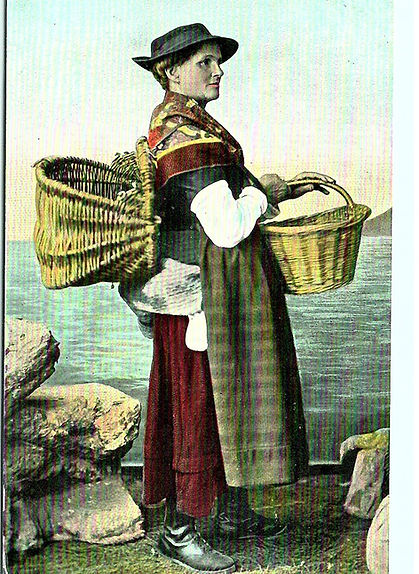
Llangwm Fisherwoman's Back Pannier
In researching the history of Pembrokeshire fisherwomen, I came across the story of Dolly Palmer, whose image became iconic during her lifetime. She followed in her mother’s footsteps and came to represent the archetypal local fisherwoman, appearing on postcards, teacups, and even chocolate boxes.
Her visibility was shaped not only by her reputation as a local beauty but also by the distinctive clothing worn by the women of the area: the flat black felt hat with a wide brim, the white scarf tied under the chin, the heavy dark skirts often tucked up to reveal a red Welsh flannel petticoat.
Reflecting on this, clothing can be powerful in shaping identity—both personal and collective. Dolly’s image wasn’t just about her as an individual; it became a symbol of a whole community and its traditions. The garments acted almost like visual shorthand for a way of life rooted in labour, resilience, and local culture.
This connects strongly to my own work with Interwoven. As I learn weaving techniques and handle materials like willow and hazel, I’m becoming more aware of how craft practices carry cultural memory. Dolly’s clothing functioned in a similar way: practical, functional, but also deeply symbolic.
It makes me think about how the objects I’m making—baskets, trays, woven pieces—might also hold traces of place, labour, and identity.
Her story encourages me to look more closely at the relationship between material, maker, and representation.
Dolly Palmer made her journey from Llangwm to Pembroke, Pembroke Dock and Tenby, three times a week for over 70 years; carrying her heavy load of oysters in a pannier on her back.
Her surviving daughters followed their mother into the trade.

Clare Revera took this basket and brought it to more contemporary look and use.
-
What does it mean when an everyday working woman becomes an icon?
-
how could my own making process honour the histories embedded in these traditional crafts?
interwoven workshops
4th February
Interwoven went to the willow and hazel coppice on the Gower.
Purpose of this trip was to see how and where willow and hazel grows, and how they are harvested.
This was very hands on expedition.
we were using secateurs, lopers and wood saw to gather the material.
we also had an opportunity to wear baskets on our backs.
Detail of the gower visit are in the recording.
11th February
Interwoven workshop with Clare, making a simple tray
Today’s Interwoven workshop with Clare focused on making a simple willow tray. She began by demonstrating how to flex willow and explaining the difference between soaked rods and green rods. This helped me understand how moisture affects flexibility and how each type behaves during weaving.
I started by forming a circle with a willow rod and securing it with a simple knot. Then I wove another rod around it. I chose to repeat this process three times, each time using willow of a different colour. This created a subtle layered effect that I really liked.
After that, I selected ten rods to act as the supports for the tray. Once these were in place, I began weaving. The process felt rhythmic and grounding, and I found myself slipping into it quite naturally.
I recorded the full method as a voice note so I can refer back to it later. I also made written notes and drew simple diagrams to document the steps and structure of the tray. Having these references feels important, especially as I continue to build my skills with willow.


12th February
making of LLangwn fisherwoman back paneer
Today was the making of the Llangwm fisherwoman back panier. The workshop group was small, which made the session feel focused and calm. Clare began by asking us to decide what size panier we wanted to make, and then she explained the differences between using willow and hazel as the frame material.
The first task was to bend the chosen rod into a circle and secure it with a zip tie. It became obvious very quickly that hazel is much harder to work with. It resisted bending, and the rod I chose kinked almost immediately. After that, I swapped to a chunky willow—possibly Flanders Red—and the process became much more manageable.
Once the frame was formed, we selected the supporting ribs and began weaving in a circular motion. I was surprised again by how natural this felt. It was as if my hands already knew what to do. There was an unexplainable familiarity in the movements—picking up rods, placing them, and working them into the structure of the basket. It felt intuitive, almost like remembering rather than learning.
A highlight of the day was sorting the willow rods into three sizes. Clare had brought a bundle grown in Somerset, and at first glance they all looked identical. But once I started handling them, I could clearly distinguish the subtle differences in thickness and flexibility. It felt like developing a new sensitivity to the material—something I hadn’t expected but really valued.
I recorded the process and Clare’s explanations as a voice note so I can refer back to it later if needed. It feels important to capture these methods while they’re still fresh.


Closing reflection on Interwoven
The Interwoven project was one of the first engaging aspects in this module.
In the true spirit of “Don’t just sit there — do something,” I threw myself into the work and allowed the process to lead me. I genuinely enjoyed the entire journey, and through it I discovered an unexpected love and hidden skill for willow weaving.
This project aligns itself beautifully within my usual practices, yet it is in a way that felt both refreshing and expansive.
If another opportunity arises to work with Coastal Tales or Interwoven, I would gladly continue exploring this direction